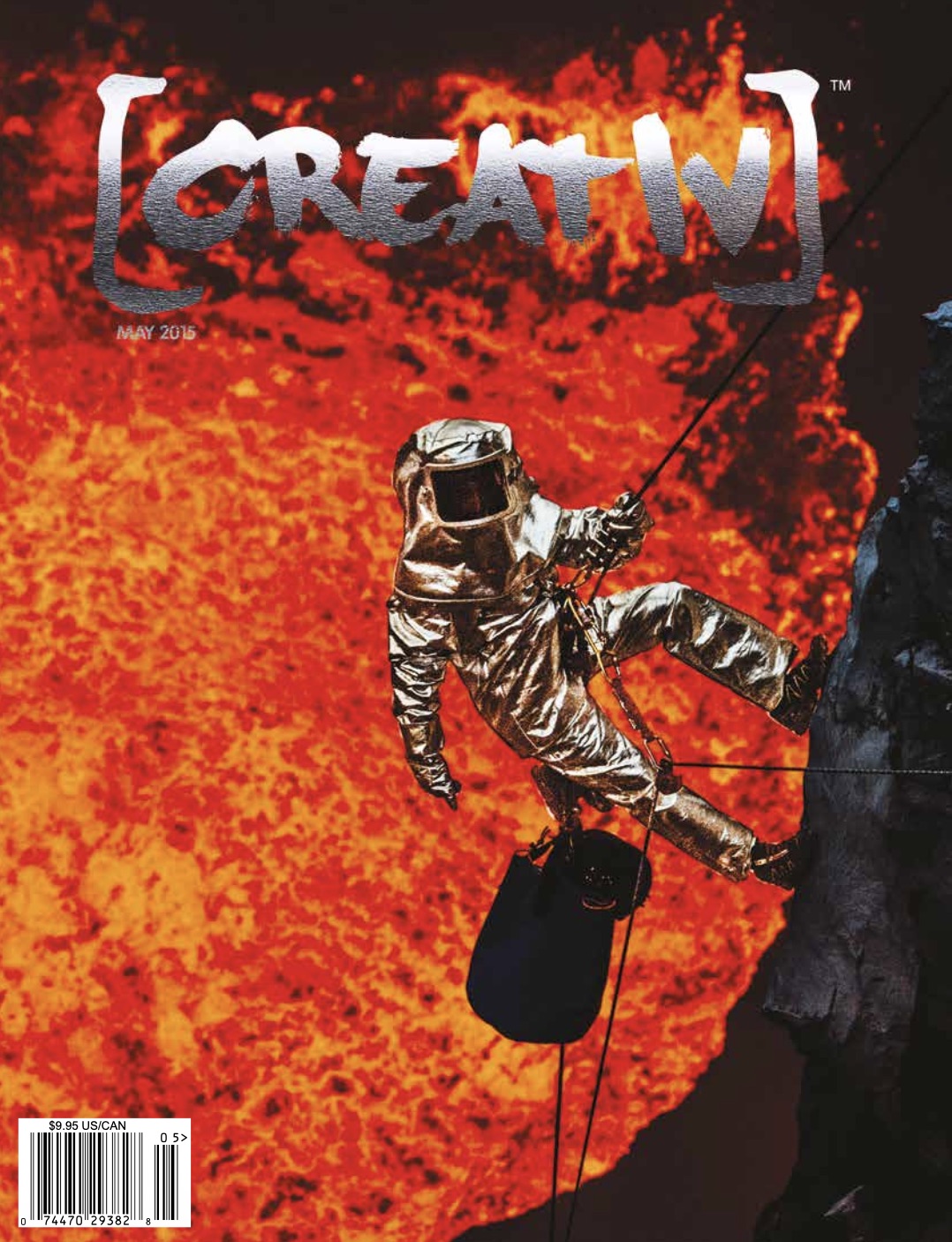
I expect Sam Cossman to look and talk like Indiana Jones. Cossman's daring descent to stand triumphantly at the edge of a lava lake inside one of the world's most active volcanoes has now captivated millions of people around the globe. Phantom drones fitted with GoPro cameras captured Cossman's thrilling and perilous adventure; then while flying back from Vanuatu to San Francisco, Cossman edited the fiery footage into a short but compelling film. With its upload to YouTube, he introduced himself, and his life as an adventurer, to the world.
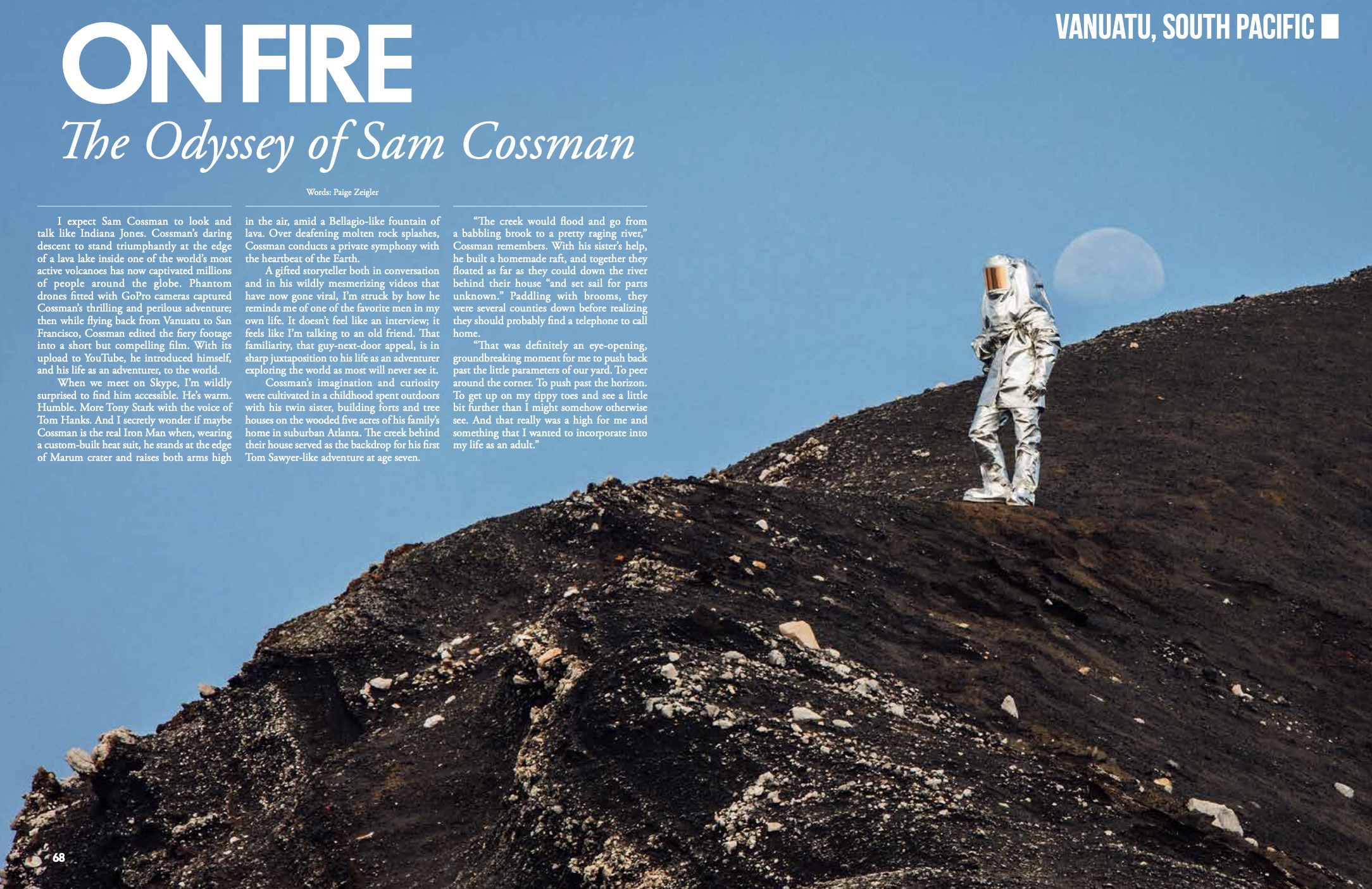
When we meet on Skype, I'm wildly surprised to find him accessible. He's warm. Humble. More Tony Stark with the voice of Tom Hanks. And I secretly wonder if maybe Cossman is the real Iron Man when, wearing a custom-built heat suit, he stands at the edge of Marum crater and raises both arms high in the air, amid a Bellagio-like fountain of lava. Over deafening molten rock splashes, Cossman conducts a private symphony with the heartbeat of the Earth.
A gifted storyteller both in conversation and in his wildly mesmerizing videos that have now gone viral, I'm struck by how he reminds me of one of the favorite men in my own life. It doesn't feel like an interview; it feels like I'm talking to an old friend. That familiarity, that guy-next-door appeal, is in sharp juxtaposition to his life as an adventurer exploring the world as most will never see it.
Cossman's imagination and curiosity were cultivated in a childhood spent outdoors with his twin sister, building forts and tree houses on the wooded five acres of his family's home in suburban Atlanta. The creek behind their house served as the backdrop for his first Tom Sawyer-like adventure at age seven.
"The creek would flood and go from a babbling brook to a pretty raging river," Cossman remembers. With his sister's help, he built a homemade raft, and together they floated as far as they could down the river behind their house "and set sail for parts unknown." Paddling with brooms, they were several counties down before realizing they should probably find a telephone to call home.
"That was definitely an eye-opening, groundbreaking moment for me to push back past the little parameters of our yard. To peer around the corner. To push past the horizon. To get up on my tippy toes and see a little bit further than I might somehow otherwise see. And that really was a high for me and something that I wanted to incorporate into my life as an adult."
Cossman's greatest self-discoveries have taken place beyond the boundaries of his comfort zone, and he has worked tirelessly to cultivate a life that fuels his curiosity and captures his intrigue for the unknown. "I think, as a kid you have this wild imagination and this sense of awe. It's certainly no surprise that over time, as adults, we're stripped of that. And I think those qualities are lovely, but they don't necessarily serve as much of a purpose in your adult life, when logic and reason replace those more ethereal concepts."
But embracing his life all-in as an adventurer is uncharted territory for Cossman. He studied business at the University of Georgia "mostly because I didn't know what I wanted to do with my life." After graduation, when his friends were putting on their ties and pursuing professional moves, Cossman recalls sitting on the couch thinking about how he could further develop himself, and he decided to travel for over a year. Completely self-made, Cossman not only paid his own way through college, but also "worked double shifts, triple shifts" to make money for his world travels. He has now traveled to all seven continents.
"It was a very defining moment for me, just from an existential perspective, to realize how other people in the world live and what else is out there, and you don't just have to be one of the conformed choices that are put in front of you after you're finishing college," says Cossman.
Returning from his travels, he had another breakthrough moment in the form of a job opportunity, working for a medical device company, that moved him from Georgia to California. "It was a flexible job, and it gave me a lot of free time. I'd have these quarter-life crises every few months where I'd say, 'What am I doing with my life? I feel like I should be doing something else. I'm not tapping into my potential.' So all the while, I have these passions for adventure and exploration."
About every four months, to mitigate those crises, Cossman would save up the money to go on a trip that would reinvigorate him. He would come back to work momentarily recharged, but then encounter the same feelings again four months later.
He attributes these mini sabbaticals to honing his anticipation for the epic journeys ahead. Knowing one day he wanted to take a long motorcycle trip, he bought a motorcycle and became an avid motorcyclist. Knowing one day he'd like to circumnavigate the globe on a boat, he took sailing lessons and fell in love with the art of sailing. Knowing he wanted to learn how to fly, he spent years saving money to become a pilot, and finally accomplished that goal. He took the same slow and methodical approach with climbing (he has climbed to Everest Base Camp, and summited Mount Lobuche, Mount Kilimanjaro, and Mount Rainier). He took up photography and videography, certain that they would someday be valuable skill sets for his future adventures.
After eight years of honing his skills and seeking adventure, it dawned on Cossman that he still wasn't living the life he wanted. "The breaking moment was when I was down in Haiti again. I was just reminded how quickly things can be taken from us, and of the fragility of life, and I was inspired by the people who lost so much," he recalls.
With a new desire to live his own life in a way that was noble and honored his passions, Cossman independently funded his startup Qwake as "the Kickstarter for new adventures," with a mission to revolutionize how new experiences come to life. "Qwake" was a name he chose by combining the words "earthquake," the event in Haiti that helped him break through, and "awake," to symbolize an awakening for people to live life to the fullest.
"I started trying to be that change that I wanted to see in the world by facilitating unique experiences for people out there who just didn't know how to find them," says Cossman. In retrospect, he recalls how the company was difficult to scale.
"I think I was approaching it at the wrong angle of trying to take all these people on all these journeys physically. In hindsight, what probably would have had a greater effect, and what I'm learning now may have a greater effect, is sharing your journeys with them and maybe doing it in a way that reaches a larger audience. And that is through media."
"We're all creative. We're all following our hearts to accomplish something in the world that is an expression of ourselves in its truest form."
Committed to redefining the art of exploration by leveraging technology and innovation as a force for good, a multidisciplinary team, including videographer Conor Toumarkine, drone pilot Simon Jardine, climber and photographer Brad Ambrose, and chief scientist Jeff Marlow, joined Cossman on the ground during his expedition to generate a first-of-its-kind 3-D model of a volcanic lava lake.
"I was super excited about bringing technology into the volcano. I felt it was a really cool and subtle way of sharing exactly what it felt like being inside a certain place without necessarily taking my attention off the thing itself."
His life of adventure isn't without danger. Cossman compares the descent inside a volcano to a reverse Everest climb. "It's equally extreme and challenging descending instead of ascending, and the return trip is coming back out rather than going back down."
And there have been moments for Cossman when things could have taken a turn for the worst. On his second descent at night, with about 600 feet above him and 600 feet below, his motorized descender that had just been serviced was found to have a leak and completely ran out of fuel.
Cossman remembers all of the ambient light from the lava illuminating the whole tunnel with a bright orange glow. "I thought, 'I will sit here on this vertical wall for a while, send my teammate up to get more fuel and a couple of parts to fix it.' And right around that time, it started raining. That rain quickly turned into a flash flood, which would send rocks barreling down the cliff. There was a moment where I just had a waterfall of multiple boulders coming down at me from 600 feet above. Quite a lot of pressure, and it's all essentially acid rain.
"There was a moment of, 'This could be the end,' but I definitely realized the severity of the situation. It very much could have gone the wrong way, and certainly I had a moment of, 'I cannot believe I got myself in this situation. What am I doing here? I should not, no human should be standing in this place.' I think that momentary lapse of shifting of my attention was quickly cut back to, 'What do I need to do next to take that next step, and resolve this problem, and get myself out of here?'"
"I still have a long life to live. I'm so young," says Cossman, 33. "Obviously, I don't want to die. But I would say I do have an unusual relationship with the concept of death. I'm not scared of it, per se. I'm not driving myself towards it. I don't have a death wish by any stretch. I love life. But I do realize that it does come with the territory, and I'm comfortable with the risk that's calculated for me."
Momentarily back in San Francisco, Cossman is focused on planning his next four adventures this year, each with different elements. His mission is to document extraordinary things, phenomena, or places that are lesser known and do it in unique ways, incorporating technology as a way to extract more knowledge and share it more effectively.
"We're all creative. We're all following our hearts to accomplish something in the world that is an expression of ourselves in its truest form, and it's so easy to get derailed. I think so long as you honor your commitment to your passion and your sense of creativity, you will find success. And it may not be in the exact form that you expect it to be in, but it will arrive."
In his lifetime, Cossman aspires to create a documentary about one of his adventures, but quickly goes on to note, "I would say that a cornerstone of exploratory success for me would be to go into outer space. I've set my sights on that, and I've made it my goal to go into space by the time I'm 40." For Cossman, this is the pinnacle of exploration. "It really is one of the last true frontiers."