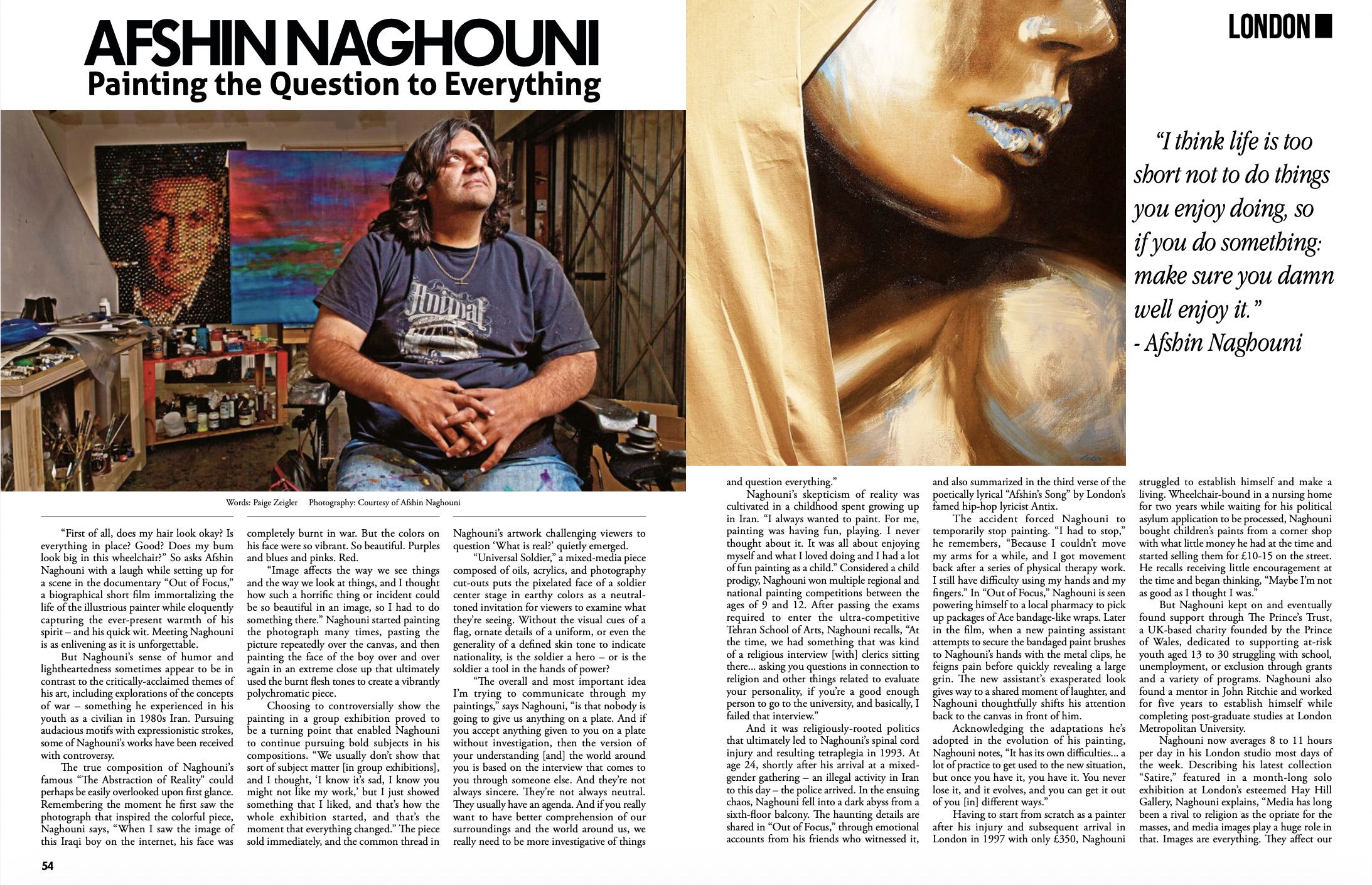
"First of all, does my hair look okay? Is everything in place? Good? Does my bum look big in this wheelchair?" So asks Afshin Naghouni with a laugh while setting up for a scene in the documentary Out of Focus, a biographical short film immortalizing the life of the illustrious painter while eloquently capturing the ever-present warmth of his spirit, and his quick wit. Meeting Naghouni is as enlivening as it is unforgettable.
But Naghouni's sense of humor and lightheartedness sometimes appear to be in contrast to the critically-acclaimed themes of his art, including explorations of the concepts of war, something he experienced in his youth as a civilian in 1980s Iran. Pursuing audacious motifs with expressionistic strokes, some of Naghouni's works have been received with controversy.
The true composition of Naghouni's famous The Abstraction of Reality could perhaps be easily overlooked upon first glance. Remembering the moment he first saw the photograph that inspired the colorful piece, Naghouni says, "When I saw the image of this Iraqi boy on the internet, his face was completely burnt in war. But the colors on his face were so vibrant. So beautiful. Purples and blues and pinks. Red.
"Image affects the way we see things and the way we look at things, and I thought how such a horrific thing or incident could be so beautiful in an image, so I had to do something there." Naghouni started painting the photograph many times, pasting the picture repeatedly over the canvas, and then painting the face of the boy over and over again in an extreme close up that ultimately used the burnt flesh tones to create a vibrantly polychromatic piece.
Choosing to controversially show the painting in a group exhibition proved to be a turning point that enabled Naghouni to continue pursuing bold subjects in his compositions. "We usually don't show that sort of subject matter [in group exhibitions], and I thought, 'I know it's sad, I know you might not like my work,' but I just showed something that I liked, and that's how the whole exhibition started, and that's the moment that everything changed." The piece sold immediately, and the common thread in Naghouni's artwork challenging viewers to question 'What is real?' quietly emerged.
Universal Soldier, a mixed-media piece composed of oils, acrylics, and photography cut-outs puts the pixelated face of a soldier center stage in earthy colors as a neutral-toned invitation for viewers to examine what they're seeing. Without the visual cues of a flag, ornate details of a uniform, or even the generality of a defined skin tone to indicate nationality, is the soldier a hero, or is the soldier a tool in the hands of power?
"The overall and most important idea I'm trying to communicate through my paintings is that nobody is going to give us anything on a plate. And if you accept anything given to you on a plate without investigation, then the version of your understanding of the world around you is based on the interview that comes to you through someone else. And they're not always sincere. They're not always neutral. They usually have an agenda."
Naghouni's skepticism of reality was cultivated in a childhood spent growing up in Iran. "I always wanted to paint. For me, painting was having fun, playing. I never thought about it. It was all about enjoying myself and what I loved doing and I had a lot of fun painting as a child." Considered a child prodigy, Naghouni won multiple regional and national painting competitions between the ages of 9 and 12. After passing the exams required to enter the ultra-competitive Tehran School of Arts, Naghouni recalls, "At the time, we had something that was kind of a religious interview with clerics sitting there asking you questions in connection to religion and other things related to evaluate your personality, if you're a good enough person to go to the university, and basically, I failed that interview."
And it was religiously-rooted politics that ultimately led to Naghouni's spinal cord injury and resulting tetraplegia in 1993. At age 24, shortly after his arrival at a mixed-gender gathering, an illegal activity in Iran to this day, the police arrived. In the ensuing chaos, Naghouni fell into a dark abyss from a sixth-floor balcony. The haunting details are shared in Out of Focus, through emotional accounts from his friends who witnessed it, and also summarized in the third verse of the poetically lyrical "Afshin's Song" by London's famed hip-hop lyricist Antix.
The accident forced Naghouni to temporarily stop painting. "I had to stop, because I couldn't move my arms for a while, and I got movement back after a series of physical therapy work. I still have difficulty using my hands and my fingers." In Out of Focus, Naghouni is seen powering himself to a local pharmacy to pick up packages of Ace bandage-like wraps. Later in the film, when a new painting assistant attempts to secure the bandaged paint brushes to Naghouni's hands with the metal clips, he feigns pain before quickly revealing a large grin. The new assistant's exasperated look gives way to a shared moment of laughter, and Naghouni thoughtfully shifts his attention back to the canvas in front of him.
Acknowledging the adaptations he's adopted in the evolution of his painting, Naghouni notes, "It has its own difficulties, a lot of practice to get used to the new situation, but once you have it, you have it. You never lose it, and it evolves, and you can get it out of you in different ways."
Having to start from scratch as a painter after his injury and subsequent arrival in London in 1997 with only £350, Naghouni struggled to establish himself and make a living. Wheelchair-bound in a nursing home for two years while waiting for his political asylum application to be processed, Naghouni bought children's paints from a corner shop with what little money he had at the time and started selling them for £10 to £15 on the street. He recalls receiving little encouragement at the time and began thinking, "Maybe I'm not as good as I thought I was."
But Naghouni kept on and eventually found support through The Prince's Trust, a UK-based charity founded by the Prince of Wales, dedicated to supporting at-risk youth aged 13 to 30 struggling with school, unemployment, or exclusion through grants and a variety of programs. Naghouni also found a mentor in John Ritchie and worked for five years to establish himself while completing post-graduate studies at London Metropolitan University.
Naghouni now averages 8 to 11 hours per day in his London studio most days of the week. Describing his latest collection Satire, featured in a month-long solo exhibition at London's esteemed Hay Hill Gallery, Naghouni explains, "Media has long been a rival to religion as the opiate for the masses, and media images play a huge role in that. Images are everything. They affect our comprehension of the world and its events. The problem is they portray a version of reality which, at best is through someone else's eyes, and at worst are lined up before our eyes with an agenda."
In his mesmerizing mixed-media compositions of women, Naghouni often incorporates images and photography from magazines to juxtapose what NUIT Magazine writer Dena Tahmasebi described as "painting beautiful layers on very ugly or hard truths." Art critic Estelle Lovatt noted in Art of England how, through Naghouni's neo-figurative style, he "captures the appeal of intimate moments in a woman's life" and "considers the controversialists' view of whether it is that Muslim women are oppressed and exploited while western women are liberated, or vice versa."
The woman who's never the subject of question in Naghouni's life, however, is his wife Tracey. When asked about the catalysts for his work, Naghouni lovingly acknowledges her careful attention to his process. "I'm basically painting all the time," he explains, noting the ubiquity of his inspiration. "Painting in my head, even when I'm not in the studio. Sometimes I'm sitting there, and you might think I'm daydreaming, and my wife is talking to me and I'm miles away, and she says, 'Oh, you're painting again, aren't you?'"
Decidedly private, Tracey didn't want to appear in Out of Focus, though her presence is tactile throughout the film. She co-designed a motorized office-table-turned-easel that enables Naghouni to reach the top of large canvases. Until recently, Naghouni was also particularly private about his accident and revealing that he was in a wheelchair. "I have never wanted people to feel sorry for me. But now that things are finally moving in the right direction for me, I feel comfortable enough to talk about my tragedies which have led me to triumphs."
Together nearly 20 years now, Tracey's influence on Naghouni's life is enduring. "When you're a disabled person in a wheelchair, people treat you differently. Everybody treats you differently. People speak to you very loud, like you're deaf. I think, 'I'm not deaf, I'm in a wheelchair.' I've learned being with Tracey that you can have a normal life. That was the biggest impact meeting Tracey had on my life: life can be normal, life can be good."
And with his trademark warmth, complete with the melodic cadence of his criss-cross British accent, Naghouni sums up his philosophy on life and work simply:
"I think life is too short not to do things you enjoy doing, so if you do something: make sure you damn well enjoy it."