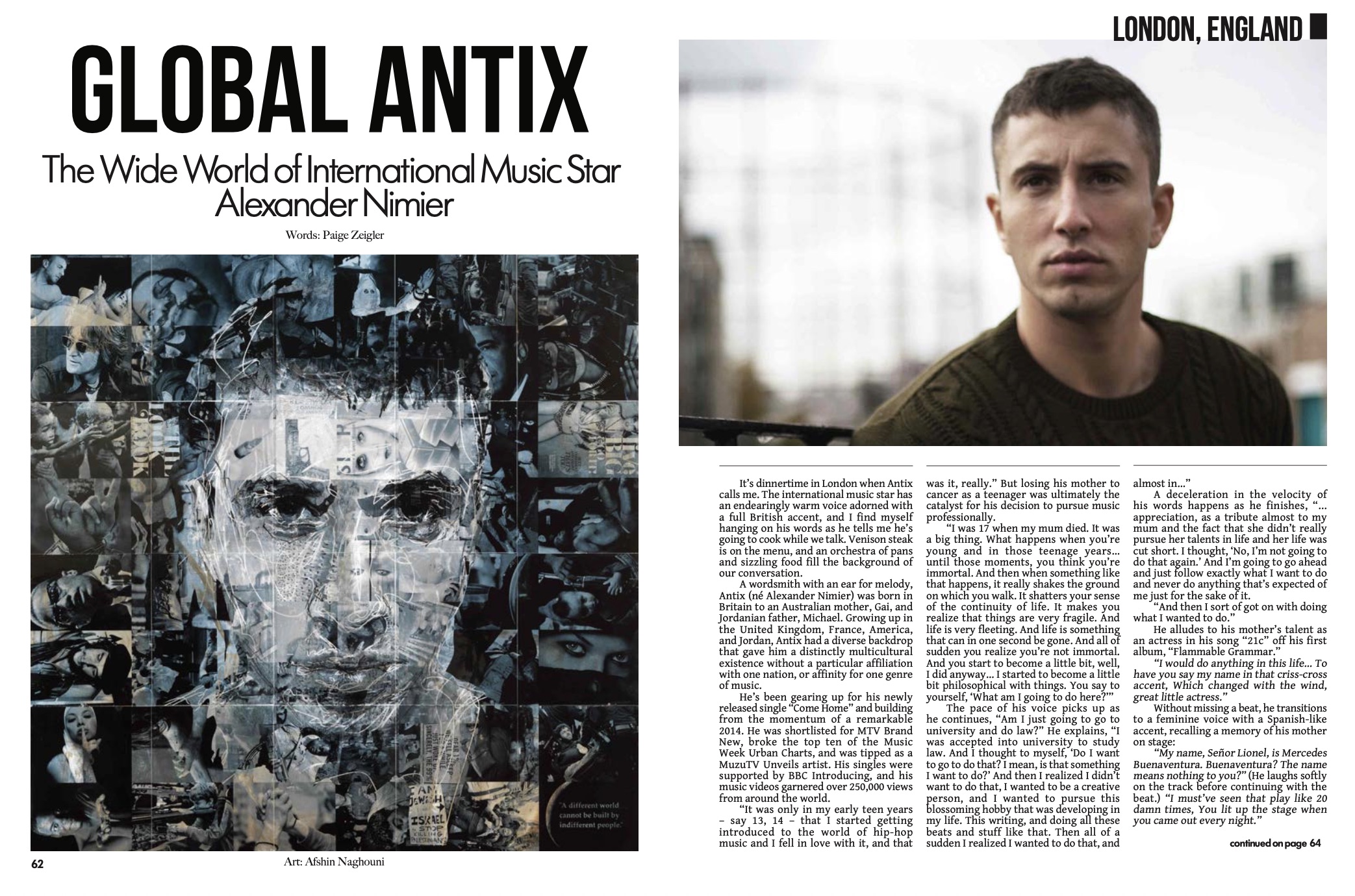
It's dinnertime in London when Antix calls me. The international music star has an endearingly warm voice adorned with a full British accent, and I find myself hanging on his words as he tells me he's going to cook while we talk. Venison steak is on the menu, and an orchestra of pans and sizzling food fill the background of our conversation.
A wordsmith with an ear for melody, Antix (né Alexander Nimier) was born in Britain to an Australian mother, Gai, and Jordanian father, Michael. Growing up in the United Kingdom, France, America, and Jordan, Antix had a diverse backdrop that gave him a distinctly multicultural existence without a particular affiliation with one nation, or affinity for one genre of music.
He's been gearing up for his newly released single "Come Home" and building from the momentum of a remarkable 2014. He was shortlisted for MTV Brand New, broke the top ten of the Music Week Urban Charts, and was tipped as a MuzuTV Unveils artist. His singles were supported by BBC Introducing, and his music videos garnered over 250,000 views from around the world.
"It was only in my early teen years, say 13, 14, that I started getting introduced to the world of hip-hop music and I fell in love with it, and that was it, really." But losing his mother to cancer as a teenager was ultimately the catalyst for his decision to pursue music professionally.
"I was 17 when my mum died. It was a big thing. What happens when you're young and in those teenage years, until those moments, you think you're immortal. And then when something like that happens, it really shakes the ground on which you walk. It shatters your sense of the continuity of life. It makes you realize that things are very fragile. And life is very fleeting. And life is something that can in one second be gone. And all of sudden you realize you're not immortal. And you start to become a little bit, well, I did anyway, I started to become a little bit philosophical with things. You say to yourself, 'What am I going to do here?'"
The pace of his voice picks up as he continues, "Am I just going to go to university and do law?" He explains, "I was accepted into university to study law. And I thought to myself, 'Do I want to go to do that? I mean, is that something I want to do?' And then I realized I didn't want to do that, I wanted to be a creative person, and I wanted to pursue this blossoming hobby that was developing in my life. This writing, and doing all these beats and stuff like that. Then all of a sudden I realized I wanted to do that, and almost in…"
A deceleration in the velocity of his words happens as he finishes, "...appreciation, as a tribute almost to my mum and the fact that she didn't really pursue her talents in life and her life was cut short. I thought, 'No, I'm not going to do that again.' And I'm going to go ahead and just follow exactly what I want to do and never do anything that's expected of me just for the sake of it.
"And then I sort of got on with doing what I wanted to do."
He alludes to his mother's talent as an actress in his song "21c" off his first album, Flammable Grammar.
"I would do anything in this life… To have you say my name in that criss-cross accent, which changed with the wind, great little actress."Without missing a beat, he transitions to a feminine voice with a Spanish-like accent, recalling a memory of his mother on stage: "My name, Señor Lionel, is Mercedes Buenaventura. Buenaventura? The name means nothing to you?" (He laughs softly on the track before continuing with the beat.)
"I must've seen that play like 20 damn times, you lit up the stage when you came out every night."Like his mother, Antix also lights up the stage. His depth as a lyricist is unrivaled. He sits behind the piano in one of his latest videos, an acoustic version of his song "Smile," accompanied by Nomakhosi Nkosi, and plays simple chords behind her bold, enigmatic vocals that open the song. His alabaster skin shows hints of flush under the lights. He's wearing a sweater, and his chiseled features become more prominent as he begins to rap his opening lines:
"I've meditated on the best way left that I can say this. I've bit the bullet and my tongue but I don't like those flavors. I want success but not because I wanna be famous."Labeling Antix as a hip-hop artist or rapper would be easy, but proves too limiting because the misogyny and gratuitous vulgarity ubiquitous today among popular songs in both genres are notably absent from his work. The stereotypical image of angry men in baggy clothes and blinged-out accessories simply doesn't apply.
Recognizing the limits of these labels, I ask how he describes his work. He wanders through a few stories aloud before settling on his answer: "I make music. It comes from a place of passion and genuinely wanting to say something and genuinely wanting to transfer something into someone's life who's listening.
"It happens to be hip-hop because I fell into hip-hop and I love the medium. I'm not particularly good at singing, and I can't play any instruments." He lets out a gentle, one-beat staccato laugh. "It sort of happened by default. It comes from a place of making real music and hoping that people connect. That's what the whole process is about."
Although his music is classified as rap and hip-hop, his songs include a variety and mix of instruments uncommon in the genre. Rich cello lines, trellised piano runs, and vibrant acoustic guitar strums grace his catalog of songs, a nod to his wide musical influences.
"Until my teenage years, I never listened to hip-hop. I never had. Not a single track. I grew up listening to all sorts of different music from opera to Charles Aznavour, to Buena Vista Social Club, to Cat Stevens, Tracy Chapman, a very wide variety of music. To this day, I have a very wide influence of music. I listen to very little hip-hop nowadays, funnily enough. Unless you're really digging away, it's really turned into something kind of boring. There are some great artists out there, but typically the mainstream stuff is just terrible."
In that sea of mediocre mainstream, Antix's music stands out. When his song "Hands Up" introduced itself with a piano-fueled beat via my Atmosphere station on Pandora Radio several years ago, I vividly remember stopping the conversation that warm summer's night to find out who was behind the clever lyricism.
"I'm making music which I hope is resonating. I'm doing things which I feel if I died tomorrow, I can at least go, 'Alright, I did my best.'"
I ask him to tell me about Pandora Radio's effect on his career. "I was in LA funnily enough, and I was living there and we got accepted into the 'Music Genome Project,' the Pandora screening process. We put it in for the album Flammable Grammar. When I left America to come back to the UK and set up shop over here, I realized that I had an unknown fan base which had been building up around the Pandora rotation. Different tracks, but a lot from 'Hands Up,' and then all of a sudden I realized there was this whole following happening. Things catalyzed from there."
"There are songs that are inherently going to be more resonant. For some reason, I'm not 100% sure why, 'Hands Up' seems to be one that has just kind of caught the sort of ear of so many people. When I made it, I never assumed that it would have this sort of cult following and this influence that it has. People talk about the lyricism in there and how certain lyrics just kind of pluck them out from a dark place."
That connection with his listeners is why Antix creates music. "I do it because when I get a message from a fan which says, 'I was in a bad place and heard one of your songs. It brought me out of that,' or 'You helped me get some perspective in my life,' or 'I was struggling with this...' Whatever it may be. I've got so many of these letters which really is the reason that I make music. It's an emotional transference, or emotional connection with who I'm doing it for."
Beyond "Hands Up," he notes that "Deep Within," a song he wrote about his mother, particularly seems to resonate with people who have experienced loss. "Letters to My Unborn," a song written as a legacy for his future children, full of all the wisdom he wants to share with them, has also ignited that spark.
Antix appears naturally adept at nurturing reciprocity with his fans. He occasionally offers full digital downloads of both albums to his Facebook followers with the message: "All I ask is that you keep spreading the word, and share the music. Bootleg it, burn it, buy it. Whatever. As long as it's being listened to, then I am happy."
Utilizing these distribution channels can mean less revenue for artists, so I ask about his business philosophy. He quickly replies, "My philosophy is there is too much shit music and crappy people in the world doing nothing to try to make the world a better place already and I don't want to be another one of those people.
"I'm not here being one of those" (his voice takes on a smaller, emo-artist, surfer-type tone) "'oh yeah, it's about my art only,' kind-of guys. But… it is about the art, and I want to do it in a way which I'm proud of. It's the long game. It's the long game which, if it pays off, it's going to be a great career forever, which it looks like it is going that way, you know, everything is gearing in the right direction."
And even though he was told he was "crazy," "too white," and "too young" for pursuing this musical path, he continues to do it his way with the world as his stage and a captive global audience.
Tonight, only venison steak is staring back at him. But somewhere, he is performing for an audience, as his sound emanates from speakers and headphones around the globe. The whole world is putting its hands up to his music. Antix has arrived.